Sandisk Investment for 2026
We found 11 online brokers that are appropriate for Trading Sandisk Platforms.
Sandisk Investment Guide
Analysis by Andrew Blumer, Updated Last updated – September 19, 2026
SanDisk's 4,000% Stock Explosion : The Flash Memory Story Behind the Numbers

How a spin off from Western Digital became the S&P 500's best performer, and why the AI revolution turned a humble memory card maker into one of the most valuable semiconductor companies on the planet.
| Metric | Value |
|---|---|
| Return Since Feb 2025 IPO | 4,000% |
| Share Price (Jun 18, 2026) | $2,040 |
| Market Capitalisation | $290B |
| Q3 FY2026 Gross Margin | 50.2% |
From a $38.50 Spin Off to the S&P 500's Biggest Winner
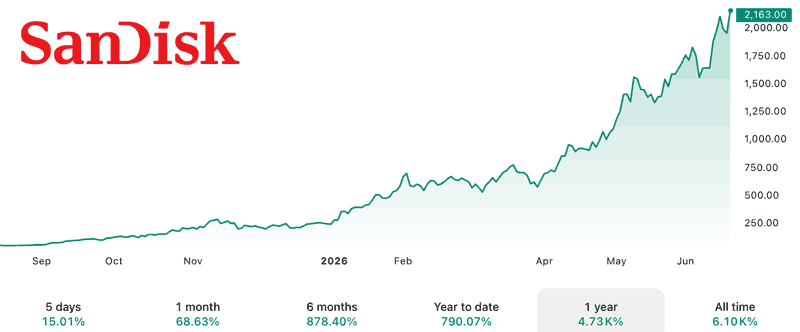
When Western Digital separated its flash memory business into an independent public company on 21 February 2025, I viewed the move as a logical corporate restructuring rather than the beginning of one of the most extraordinary stock market stories of the decade. SanDisk Corporation began trading on the Nasdaq under the ticker SNDK at approximately $38.50 per share, a valuation that reflected widespread skepticism toward the NAND flash memory industry. Investors had spent years watching memory manufacturers endure boom-and-bust cycles, periods of oversupply, and collapsing profit margins. Few expected that within just sixteen months SanDisk's share price would surge above $2,000, delivering a return approaching 4,000% and becoming one of the strongest performers ever seen in the semiconductor sector.
In my view, the rally was not driven by speculation alone. It was the result of several powerful forces converging at exactly the right moment: the company's separation from Western Digital, a historic acceleration in artificial intelligence infrastructure spending, and a severe imbalance between NAND supply and demand. Together, these factors transformed SanDisk from a cyclical memory manufacturer into a strategic supplier of one of the most critical resources powering the AI economy.
To understand how SanDisk achieved such remarkable gains and whether those gains can be sustained, it is important to examine both the structural changes that reshaped the company after the spin-off and the unprecedented surge in demand for flash storage created by the AI revolution.
In less than a year as a standalone company, SanDisk outperformed every other stock in the S&P 500, surpassing even many of the world's largest technology companies as investors rushed to gain exposure to AI infrastructure. Stocktwits Markets, March 2026
The Spin Off That Changed Everything
For many years, SanDisk operated as part of Western Digital, sharing resources and financial reporting with the company's hard disk drive business. From my perspective, this structure made it difficult for investors to properly value either segment. The HDD and NAND businesses serve different markets, follow different investment cycles, and have very different growth prospects. While HDDs remain important for cold storage and archival data, flash memory has increasingly become the preferred solution for high-performance computing, cloud infrastructure, and artificial intelligence workloads.
Analysts had argued for years that Western Digital's individual businesses were worth more separately than together. In October 2023, management finally agreed and announced plans to separate the flash business. Under the transaction, Western Digital distributed approximately 80.1% of SanDisk's shares to existing shareholders, with investors receiving one-third of a SanDisk share for each Western Digital share owned as of the record date on 12 February 2025.
The strategic rationale was compelling. As a standalone company, SanDisk could allocate capital independently, negotiate long-term supply agreements directly with customers, optimize manufacturing investments, and pursue growth opportunities without competing internally for resources with the HDD division. Investors would also gain a pure-play flash memory company whose valuation reflected its own prospects rather than the blended performance of two very different businesses.
What makes the story remarkable is that the spin-off occurred just as the global AI infrastructure buildout entered an entirely new phase of growth.

The AI Data Cycle : Why Flash Storage Became Critical Infrastructure
In my opinion, one of the biggest misconceptions during the early AI boom was the belief that graphics processors alone would capture the value created by artificial intelligence. While companies such as Nvidia received most of the attention, every AI system depends on a vast ecosystem of supporting infrastructure. High-speed networking, power systems, cooling technologies, and storage all became critical bottlenecks as AI models grew larger and more complex.
The technology industry increasingly began referring to this trend as the AI Data Cycle. Training large language models requires storing enormous datasets, model checkpoints, embeddings, vector databases, and inference caches. Every user interaction generates new data that must be processed, stored, retrieved, and analyzed. As model sizes expanded from billions to trillions of parameters, storage requirements grew alongside compute requirements.
SanDisk's management repeatedly emphasized this shift during earnings calls, highlighting that AI workloads are becoming increasingly token-intensive. One particularly important development involves Key-Value caching, commonly known as KV cache, which allows AI models to store previously processed context and dramatically reduce computational costs during inference. Industry forecasts suggest that KV cache requirements alone could generate between 75 and 100 exabytes of additional NAND demand in 2027, with demand potentially doubling again in subsequent years.
At the same time, hyperscale cloud providers, enterprise AI deployments, sovereign AI projects, and edge computing networks began investing aggressively in flash-based storage infrastructure. Industry forecasts indicate that data centres are expected to become the largest end market for NAND flash by 2026, overtaking consumer electronics for the first time. For a company focused entirely on flash memory, this represented a structural demand shift unlike anything the industry had previously experienced.
The Silent SD Memory Squeeze : How a Supply Crisis Amplified the Rally
While AI demand provided the catalyst, I believe the most important driver of SanDisk's explosive stock performance was the supply shortage that emerged simultaneously. The memory industry spent much of 2023 and early 2024 dealing with weak demand, falling prices, and excess inventory. In response, manufacturers reduced capital expenditures, delayed expansion projects, and cut wafer production to protect profitability.
Those decisions appeared sensible at the time, but they left the industry unprepared for the sudden surge in enterprise AI storage demand that followed. By 2025, hyperscale data centre operators were ordering storage capacity at levels few analysts had anticipated. The result was a rapidly widening gap between available supply and customer requirements.
The situation became even more severe because semiconductor manufacturing resources were being redirected elsewhere. The explosive demand for AI accelerators from companies such as Nvidia and AMD created an unprecedented need for High Bandwidth Memory (HBM), a critical component used in advanced AI chips. Semiconductor equipment manufacturers prioritized HBM-related production, reducing the availability of certain tools required to expand NAND manufacturing capacity. This created a bottleneck that many industry observers underestimated.
Analysts eventually began referring to the imbalance as the Silent Squeeze of 2026. Unlike previous shortages driven primarily by consumer demand, this shortage was rooted in the infrastructure layer of the AI economy. Enterprise SSD prices increased sharply, utilization rates across major NAND producers climbed toward capacity limits, and industry profitability improved dramatically.
SanDisk benefited more than most competitors because it entered the shortage with significant exposure to enterprise storage markets. Gross margins, which had struggled near the low twenties during the industry downturn, expanded above 50% by the third quarter of fiscal 2026. Revenue growth accelerated, free cash flow improved substantially, and investors began valuing the company less as a cyclical memory manufacturer and more as a strategic supplier to the AI ecosystem.
The company capitalized aggressively on its improved position. Reports from major investment banks indicated that SanDisk planned substantial price increases on high-capacity 3D NAND products used in enterprise SSDs. Management also disclosed that much of its 2026 production capacity had already been committed to customers, while demand visibility for 2027 remained exceptionally strong. Long-term supply agreements worth tens of billions of dollars further strengthened confidence in future earnings.
At the same time, public comments from major technology leaders reinforced the bullish narrative. Nvidia CEO Jensen Huang warned of a potential multi-year shortage across critical AI infrastructure components, a statement many investors interpreted as confirmation that demand would continue to outpace supply. For companies positioned at the infrastructure layer of the AI stack, including storage providers such as SanDisk, the message was clear: the AI boom was no longer a short-term trend but a long-duration investment cycle.

Where SanDisk Is Actually Used
Despite the financial headlines, it is worth examining the concrete applications that underpin this demand. SanDisk's products address four distinct markets, each of which is growing for different but complementary reasons.
| Use Case | Description |
|---|---|
| AI Data Centres & Hyperscalers | SanDisk's enterprise NVMe SSDs sit inside the server racks of the world's largest cloud providers. Every ChatGPT query, Gemini response, and Claude conversation relies on high speed persistent storage. SanDisk's UltraQLC SN670, a 256 TB SSD announced at FMS 2025 and shipping in 2026, is designed specifically for AI data ingest, preparation, and data lake workloads. |
| Smartphones & Mobile Devices | SanDisk's embedded NAND storage powers the internal memory of billions of smartphones, tablets, and connected devices. As Edge AI expands, device manufacturers require larger flash capacities to store AI models and data locally. SanDisk supplies both UFS chips and microSD expansion cards. |
| Gaming Consoles & Set Top Boxes | Modern gaming titles often exceed 100 GB in size. PlayStation and Xbox ecosystems rely on NVMe SSD storage to reduce load times and improve performance. SanDisk produces SSDs for gaming consoles, PCs, notebooks, and entertainment hardware where speed and endurance are essential. |
| Professional Cameras & Content Creation | The SanDisk Extreme and SanDisk Professional product lines are widely used in broadcast production, wildlife photography, and filmmaking. As 4K and 8K video production becomes more common, creators increasingly depend on high capacity, high speed storage solutions. |
| Automotive & Industrial IoT | Connected and autonomous vehicles generate vast amounts of sensor data that must be stored and processed in real time. Industrial IoT systems and smart infrastructure also require durable, high endurance flash memory capable of operating in demanding environments. |
| Enterprise Private Cloud | Companies running private AI infrastructure, including financial institutions and healthcare providers, rely heavily on enterprise SSDs. SanDisk's NVMe portfolio helps accelerate workloads while allowing organisations to keep sensitive data within their own environments. |
The Technology Driving the Margins
While much of the market's attention has focused on AI demand and supply shortages, I believe the technology underlying SanDisk's products is equally important to understanding the company's remarkable financial performance. Demand alone does not create sustainable competitive advantages. What at the end of the day determines long-term profitability is whether a company can manufacture higher-performance products at lower costs than its competitors. In SanDisk's case, much of that advantage comes from its latest generation of NAND technology.
At the centre of this strategy is the company's BiCS8 3D NAND architecture, developed through its long-standing technology partnership with Kioxia. BiCS8 utilizes 218-layer stacking technology combined with a CMOS directly Bonded to Array (CBA) design, an architecture that separates memory cell manufacturing from peripheral circuitry before bonding them together. From my perspective, this represents one of the most significant advances in NAND engineering in recent years because it improves storage density, increases performance, reduces power consumption, and enables more efficient manufacturing.
The practical implications are substantial. By stacking more layers vertically, SanDisk can increase storage capacity without significantly increasing the physical size of each chip. This allows data centre customers to deploy higher-capacity SSDs while reducing rack space, cooling requirements, and energy consumption. In an era where hyperscale operators are investing billions into AI infrastructure, these efficiency gains have become increasingly valuable.
Equally important is the impact on manufacturing economics. As BiCS8 production scales and yields improve, the cost of producing each gigabyte of storage declines. This creates a powerful operating leverage effect: revenue rises through higher-capacity products while production costs fall through process maturity. By the end of fiscal 2026, BiCS8 is expected to account for the majority of SanDisk's manufacturing output, positioning the company to benefit from both stronger pricing and improved production efficiency. In my view, this technology transition is one of the primary reasons gross margins have expanded so dramatically compared with previous NAND cycles.
Another area that I believe investors may be underestimating is SanDisk's development of High Bandwidth Flash (HBF), an emerging architecture designed specifically for the evolving needs of artificial intelligence workloads. Traditional AI systems rely heavily on High Bandwidth Memory (HBM), which provides extremely fast data transfer speeds but remains expensive, power-intensive, and limited in capacity. As AI models continue growing in size, memory capacity is becoming just as important as memory speed.
HBF is designed to address this challenge by combining the density and cost advantages of NAND flash with architectural innovations that improve data accessibility for AI applications. According to industry research, HBF could offer between eight and sixteen times the storage capacity of HBM at similar system-level costs. While it cannot match HBM's raw bandwidth, it may provide a more economical solution for workloads that require storing vast amounts of data rather than continuously accessing it at maximum speed.
This distinction is becoming increasingly important as AI inference workloads scale. Applications such as retrieval-augmented generation, vector databases, recommendation engines, digital twins, and large-scale KV cache systems require enormous memory footprints. In many cases, storing more information closer to the processor can be more valuable than achieving the absolute highest bandwidth. HBF is being positioned to serve precisely this market segment.
What makes the opportunity particularly compelling is the ecosystem forming around the technology. SanDisk has been collaborating with major memory manufacturer SK Hynix and leading academic institutions such as KAIST to establish open standards and accelerate commercial adoption. If successful, HBF could create an entirely new category of AI memory infrastructure, expanding the company's addressable market beyond traditional SSDs and storage devices.
From my perspective, this is one of the most overlooked aspects of the SanDisk story. Investors often view the company as simply a beneficiary of higher NAND prices. However, the longer term investment case may depend just as much on its ability to develop next-generation memory technologies that address the growing bottlenecks in AI infrastructure. If HBF achieves broad adoption and BiCS8 continues delivering manufacturing advantages, SanDisk could evolve from a cyclical storage supplier into a foundational technology provider for the AI era.
From Memory Cards to Market Darling : SanDisk's Journey Since 2020
| Year / Date | Event |
|---|---|
| 2020 | SanDisk operates as a wholly owned division of Western Digital. Consumer flash demand is steady but unremarkable. The company's products power phones, cameras, and USB drives. WDC stock trades below $50. NAND is widely regarded as a commodity with thin margins. |
| 2021 to 2022 | Post pandemic electronics demand drives a NAND shortage. Prices rise briefly, then collapse as manufacturers rush to expand capacity. Western Digital's flash division sees volatile earnings. The case for separation begins building internally. |
| October 2023 | Western Digital announces its intention to separate the HDD and flash businesses into two independent public companies. The strategic rationale: focused management, separate capital structures, and cleaner investor narratives for each business. |
| February 2025 | SanDisk Corporation begins trading on the Nasdaq under SNDK at approximately $38.50 per share. The stock dips briefly to a low of $27.89 in April 2025 as investors wait for clarity on the AI demand thesis. Total market capitalisation at launch is modest by semiconductor standards. |
| Mid 2025 | The AI infrastructure buildout accelerates. SanDisk reports Q1 FY2026 revenue of $2.31 billion, a 26% sequential increase. Gross margins expand rapidly. Enterprise SSD contracts are signed at volumes that sell out 2026 capacity. The stock begins its extraordinary climb. |
| Early 2026 | NAND flash prices for enterprise SSDs double. SanDisk's gross margin exceeds 50%. Cantor Fitzgerald raises its price target to $1,000 from $580, then to $2,900 from $1,800. Bernstein, Mizuho, and BofA all lift targets. The stock hits $725 on 3 February, then continues climbing. |
| June 2026 | SNDK sets an all time high of $2,167.33 on 16 June 2026. Year to date returns exceed 692%. The 52 week range spans $40.10 to $2,167.33. SanDisk's market capitalisation stands at approximately $290 billion. Jensen Huang's multi year silicon drought prediction is cited by analysts as a structural demand guarantee. |
The Financial Engineering Behind the Margins
The revenue and margin transformation at SanDisk is not merely a function of higher prices it reflects a deliberate shift in product mix. The company has leaned aggressively into QLC (Quad Level Cell) flash products, which store four bits per cell rather than three. QLC reduces manufacturing cost per gigabyte substantially, and as SanDisks Stargate controller technology matures, the performance gap between QLC and more expensive TLC NAND has narrowed significantly. The result is a business that can simultaneously lower per unit manufacturing costs and charge higher prices in a supply constrained market.
SanDisks fiscal year 2025 full year revenue was $7.4 billion. In the first three quarters of fiscal 2026, the company has been tracking well ahead of that figure, with quarterly revenues of $2.31 billion, $3.02 billion, and $3.34 billion respectively. The third quarter gross margin of 50.2% would have been unimaginable when the company was still inside Western Digital and lumped in with lower margin HDD operations.
What SanDisks Position in the Flash Stack Actually Means
It is tempting to view SanDisk purely as a commodity memory maker that is benefitting from a cyclical upturn. That framing misses the structural shift underway. The company holds approximately 13% of the global NAND market, and while it ranks fifth in total volume, it is increasingly seen as the most agile player in the high margin enterprise segment. Its vertical integration from raw NAND wafer fabrication to final enterprise SSD firmware gives it pricing power and product differentiation that pure fabless players cannot replicate.
| Technology Layer | Description |
|---|---|
| AI Workloads | LLM training, inference, KV cache, retrieval-augmented generation (RAG) systems, agentic AI, and other AI applications require persistent, high-throughput flash storage at scale. |
| Enterprise SSDs | SanDisk NVMe SSDs are deployed inside hyperscale data centre servers, providing the storage infrastructure that supports GPU clusters and AI computing environments. |
| BiCS8 NAND | 218-layer 3D NAND flash architecture developed in partnership with Kioxia, serving as the foundational storage technology underpinning SanDisk's product portfolio. |

What I find particularly important about the AI-driven storage boom is that artificial intelligence is not simply adding another layer of demand on top of existing NAND consumption. It is fundamentally changing how data is used. Traditional enterprise storage workloads often involved data that was written once, archived, and only accessed occasionally. AI systems operate very differently. Large language models, retrieval-augmented generation (RAG) platforms, recommendation engines, autonomous systems, and AI agents continuously read, update, retrieve, and process vast amounts of information in real time.
As a result, storage utilisation rates have increased dramatically. Every AI query can trigger multiple storage operations, including retrieval of training data, vector database searches, access to model weights, KV cache updates, and storage of inference outputs. The growth of AI applications has effectively transformed dormant data into active infrastructure. Industry estimates suggest that only a small percentage of enterprise data was historically accessed on a regular basis, but AI systems are increasingly extracting value from decades of accumulated information. SanDisk's CEO referred to this phenomenon as awakening historical data, and I believe it may be one of the most important long-term drivers of flash demand. Once organizations discover new value in previously unused datasets, storage requirements become structurally larger regardless of whether a specific AI model succeeds or fails.
What makes this trend particularly significant is that it extends beyond generative AI. Financial institutions are using AI to analyse decades of transaction records, healthcare organizations are processing historical patient data, manufacturers are applying machine learning to years of operational information, and governments are digitising and indexing vast archives of documents. In each case, flash storage becomes a critical performance layer that enables rapid retrieval and processing of data that would otherwise remain inaccessible. This suggests that the AI storage cycle may be broader and more durable than many investors currently appreciate.
The Risks the Bulls Are Choosing to Ignore
Despite the compelling growth narrative, I believe investors should remain aware that SanDisk operates in one of the most cyclical industries in technology. The company's recent success has been driven not only by strong demand but also by unusually favourable supply conditions. History shows that memory markets rarely remain constrained forever. When prices rise sharply, manufacturers eventually respond by increasing production capacity, and those expansions often lead to periods of oversupply and declining profitability.
Morningstar has repeatedly emphasized this risk, arguing that NAND flash remains largely a commodity product with limited differentiation between suppliers. While companies can compete on manufacturing efficiency, controller technology, firmware, and customer relationships, the underlying memory itself remains highly interchangeable. In Morningstar's view, SanDisk lacks a durable economic moat that would permanently protect it from future pricing pressure. If industry supply catches up with demand, margins could compress much faster than many investors currently expect.
The industry's largest players, including Samsung, SK Hynix, Micron, and Kioxia, are all investing heavily in next-generation NAND manufacturing technologies. New fabrication capacity and higher-layer NAND architectures are expected to improve production efficiency significantly over the coming years. If substantial volumes of new supply enter the market during 2027 and beyond, the pricing environment that currently benefits SanDisk could weaken considerably. This is a pattern that has repeated multiple times throughout semiconductor history.
Valuation represents another concern. After appreciating from approximately $40 to more than $2,000 within sixteen months, SanDisk's share price reflects exceptionally optimistic expectations. At a trailing price-to-earnings ratio exceeding 69 times earnings, investors are effectively assuming that elevated margins, strong pricing power, and AI-driven demand growth will persist for years. Any evidence of slowing demand, delayed AI infrastructure spending, or faster-than-expected capacity expansion could trigger significant volatility. The stock's extraordinary rise has also pushed many technical indicators into territory typically associated with overbought conditions.
Some market observers have already begun sounding cautionary notes. Prediction markets and trading communities have described SNDK as one of the most overbought stocks ever observed, while several institutional investors have reduced exposure following the rally. Notably, veteran investor Stanley Druckenmiller exited his position after benefiting from the stock's appreciation. While a single investor's decision does not determine a company's future, it does suggest that some sophisticated market participants believe a substantial portion of the upside may already be reflected in the share price.
On the other hand, the bullish argument remains powerful. Supporters contend that the current cycle differs fundamentally from previous NAND booms because the demand drivers are structural rather than purely cyclical. The rapid growth of KV cache infrastructure, the multi-year expansion of AI data centres, sovereign AI initiatives, edge computing deployments, and the migration from hard-disk-based architectures to flash-dominant systems all point toward sustained demand growth. If these trends continue, NAND pricing could remain elevated for much longer than historical memory cycles would suggest.
From my perspective, the central question is not whether AI will continue to require more storage it almost certainly will. The more important question is whether demand can continue growing fast enough to absorb the enormous wave of new NAND capacity expected later this decade. If it can, SanDisk may justify much of its remarkable valuation. If it cannot, the company could eventually face the same cyclical pressures that have defined the memory industry for decades. The next two years will likely determine which of those outcomes becomes reality.
The SanDisk Stock Verdict
SanDisks transformation from a Western Digital division into a standalone $290 billion public company is one of the more remarkable corporate stories of the past decade. The spin off unlocked value that had long been obscured inside a diversified storage conglomerate. The timing placing an independent flash memory company into a market experiencing the sharpest AI driven demand surge in semiconductor history was either fortunate or extraordinarily well planned, depending on how charitably one reads the historical record.
The fundamental underpinning is real. SanDisks products are not optional extras for the companies building AI infrastructure they are critical components without which the training, inference, and data management layers of modern AI systems cannot function. Every ChatGPT query, every Gemini document summary, and every enterprise RAG deployment writes and reads from high speed persistent flash storage, much of it manufactured by SanDisk. That demand is not going away.
What is genuinely uncertain is whether a 4,000% return in sixteen months has already priced in the next several years of earnings growth and whether the supply demand dislocation that drove margins to 50% can persist once the semiconductor industry finishes its painful capital expenditure cycle.
We have conducted extensive research and analysis on over multiple data points on Sandisk Investment to present you with a comprehensive guide that can help you find the most suitable Sandisk Investment. Below we shortlist what we think are the best Sandisk Trading Platforms after careful consideration and evaluation. We hope this list will assist you in making an informed decision when researching Sandisk Investment.
Reputable Sandisk Investment Checklist
Selecting a reliable and reputable online Sandisk Trading Platforms trading brokerage involves assessing their track record, regulatory status, customer support, processing times, international presence, and language capabilities. Considering these factors, you can make an informed decision and trade Sandisk Trading Platforms more confidently.
Selecting the right online Sandisk Trading Platforms trading brokerage requires careful consideration of several critical factors. Here are some essential points to keep in mind:
- Ensure your chosen Sandisk Trading Platforms broker has a solid track record of at least two years in the industry.
- Verify that the Sandisk Trading Platforms broker has a customer support team of at least 15 members responsive to queries and concerns.
- Check if the Sandisk Trading Platforms broker operates under the regulatory framework of a jurisdiction that can hold it accountable for any misconduct or resolve disputes fairly and impartially.
- Ensure that the Sandisk Trading Platforms broker can process deposits and withdrawals within two to three days, which is crucial when you need to access your funds quickly.
- Look for Sandisk Trading Platforms brokers with an international presence in multiple countries, offering its clients local seminars and training programs.
- Ensure the Sandisk Trading Platforms broker can hire staff from diverse locations worldwide who can communicate fluently in your local language.
Our team have listed brokers that match your criteria for you below. All brokerage data has been summarised into a comparison table. Scroll down.
Compare Key Features of Sandisk Trading Platforms in Our Brokerage Comparison Table
When choosing a broker for Sandisk Trading Platforms trading, it's essential to compare the different options available to you. Our Sandisk Trading Platforms brokerage comparison table below allows you to compare several important features side by side, making it easier to make an informed choice.
- Minimum deposit requirement for opening an account with each Sandisk Trading Platforms broker.
- The funding methods available for Sandisk Trading Platforms with each broker.
- The types of instruments you can trade with each Sandisk Trading Platforms broker, such as forex, stocks, commodities, and indices.
- The trading platforms each Sandisk Trading Platforms broker provides, including their features, ease of use, and compatibility with your devices.
- The spread type (if applicable) for each Sandisk Trading Platforms broker affects the cost of trading.
- The level of customer support each Sandisk Trading Platforms broker offers, including their availability, responsiveness, and quality of service.
- Whether each Sandisk Trading Platforms broker offers Micro, Standard, VIP, or Islamic accounts to suit your trading style and preferences.
By comparing these essential features, you can choose a Sandisk Trading Platforms broker that best suits your needs and preferences for Sandisk Trading Platforms. Our Sandisk Trading Platforms broker comparison table simplifies the process, allowing you to make a more informed decision.
Top 15 Sandisk Trading Platforms of 2026 compared
Here are the top Sandisk Trading Platforms.
Compare Sandisk Trading Platforms brokers for min deposits, funding, used by, benefits, account types, platforms, and support levels. When searching for a Sandisk Trading Platforms broker, it's crucial to compare several factors to choose the right one for your Sandisk Trading Platforms needs. Our comparison tool allows you to compare the essential features side by side.
All brokers below are Sandisk Trading Platforms. Learn more about what they offer below.
You can scroll left and right on the comparison table below to see more Sandisk Trading Platforms that accept Sandisk Trading Platforms clients.
| Broker |
IC Markets

|
eToro

|
XTB
|
XM
|
Pepperstone

|
AvaTrade

|
FP Markets

|
SpreadEx

|
EasyMarkets

|
FXPro

|
Admiral

|
|---|---|---|---|---|---|---|---|---|---|---|---|
| Rating | |||||||||||
| Regulation | International Capital Markets Pty Ltd (Australia) (ASIC) Australian Securities & Investments Commission Licence No. 335692, Seychelles Financial Services Authority (FSA) (SD018), IC Markets (EU) Ltd (CySEC) Cyprus Securities and Exchange Commission with License No. 362/18, Capital Markets Authority(CMA) Kenya IC Markets (KE) Ltd, Securities Commission of The Bahamas (SCB) IC Markets (Bahamas) Ltd | FCA (Financial Conduct Authority) eToro (UK) Ltd (FCA reference 583263), eToro (Europe) Ltd CySEC (Cyprus Securities Exchange Commission), ASIC (Australian Securities and Investments Commission) eToro AUS Capital Limited ASIC license 491139, CySec (Cyprus Securities and Exchange Commission under the license 109/10), FSAS (Financial Services Authority Seychelles) eToro (Seychelles) Ltd license SD076, eToro (ME) Limited (ADGM) Abu Dhabi (UAE) number 220073, eToro (Europe) Ltd (AMF) Autorité des marchés financiers as a digital assets provider France | FCA (Financial Conduct Authority reference 522157) XTB Limited, CySEC (Cyprus Securities and Exchange Commission reference 169/12), DFSA (Dubai Financial Services Authority XTB MENA Limited licensed 8 July 2021), FSA (Financial Services Authority Seychelles license number SD148), FSCA (Financial Sector Conduct Authority XTB Africa (Pty) Ltd licensed 10 August 2021), KNF (Komisja Nadzoru Finansowego Polish Financial Supervision Authority) | Financial Sector Conduct Authority (FSCA) (49976) XM ZA (Pty) Ltd, Financial Services Commission (FSC) (000261/27) XM Global Limited, Cyprus Securities and Exchange Commission (CySEC) (license 120/10) Trading Point of Financial Instruments Ltd, Australian Securities and Investments Commission (ASIC) (number 443670) Trading Point of Financial Instruments Pty Ltd | Financial Conduct Authority (FCA), Australian Securities and Investments Commission (ASIC), Cyprus Securities and Exchange Commission (CySEC), Federal Financial Supervisory Authority (BaFin), Dubai Financial Services Authority (DFSA), Capital Markets Authority of Kenya (CMA), Pepperstone Markets Limited is incorporated in The Bahamas (number 177174 B), Licensed by the Securities Commission of The Bahamas (SCB) number SIA-F217 | Australian Securities and Investments Commission (ASIC) Ava Capital Markets Australia Pty Ltd (406684), South African Financial Sector Conduct Authority (FSCA) Ava Capital Markets Pty Ltd (45984), Financial Services Agency (Japan FSA) Ava Trade Japan K.K. (1662), Financial Futures Association of Japan (FFAJ) Ava Trade Japan K.K. (1574), Abu Dhabi Global Markets (ADGM) / Financial Regulatory Services Authority (FRSA) Ava Trade Middle East Ltd (190018), Central Bank of Ireland (C53877) AVA Trade EU Ltd, Polish Financial Supervision Authority (KNF) AVA Trade EU Ltd (branch authorisation), British Virgin Islands Financial Services Commission (BVI) Ava Trade Markets Ltd (SIBA/L/13/1049), Israel Securities Authority (ISA) ATrade Ltd (514666577), Financial Superintendence of Colombia (SFC 0261 of 2024), Investment Industry Regulatory Organization of Canada through Friedberg Direct (IIROC) | CySEC (Cyprus Securities and Exchange Commission) (371/18), ASIC AFS (Australian Securities and Investments Commission) (286354), FSP (Financial Sector Conduct Authority in South Africa) (50926), Financial Services Authority Seychelles (FSA) (SD 130) | FCA (Financial Conduct Authority) (190941), Gambling Commission (Great Britain) (8835), licence in Ireland as remote bookmaker for fixed odds betting licence number 1016176 | Easy Forex Trading Ltd is regulated by CySEC (License 079/07). This is the only entity that onboards EU clients. easyMarkets Pty Ltd is regulated by ASIC (AFS License 246566), EF Worldwide Ltd (Seychelles) is regulated by FSA (License SD056), EF Worldwide Ltd (British Virgin Islands) is regulated by FSC (License SIBA/L/20/1135), EF Worldwide (PTY) Ltd is regulated by FSCA (License 54018) | FCA (Financial Conduct Authority) (509956), CySEC (Cyprus Securities and Exchange Commission) (078/07), FSCA (Financial Sector Conduct Authority) (45052), SCB (Securities Commission of The Bahamas) (SIA-F184), FSA (Financial Services Authority of Seychelles) (SD120) | Financial Conduct Authority (FCA) (Licence No. 595450), Cyprus Securities and Exchange Commission (CySEC) (Licence No. 201/13), Financial Services Authority of Seychelles (FSA) (Licence No. SD073), Estonian Financial Supervision Authority (EFSA) (Licence No. 4.1-1/46) |
| Min Deposit | 200 | 50 | No minimum deposit | 5 | No minimum deposit | 100 | 100 | No minimum deposit | 25 | 100 | 100 |
| Funding |
|
|
|
|
|
|
|
|
|
|
|
| Used By | 200,000+ | 40,000,000+ | 2,000,000+ | 15,000,000+ | 830,000+ | 400,000+ | 200,000+ | 60,000+ | 250,000+ | 11,200,000+ | 30,000+ |
| Benefits |
|
|
|
|
|
|
|
|
|
|
|
| Accounts |
|
|
|
|
|
|
|
|
|
|
|
| Platforms | MT5, MT4, MetaTrader WebTrader, Mobile Apps, iOS (App Store), Android (Google Play), MetaTrader iPhone/iPad, MetaTrader Android Google Play, MetaTrader Mac, cTrader, cTrader Web, cTrader iPhone/iPad, cTrader iMac, cTrader Android Google Play, cTrader Automate, cTrader Copy Trading, TradingView, Virtual Private Server, Trading Servers, MT4 Advanced Trading Tools, IC Insights, Trading Central | eToro Trading App, Mobile Apps, iOS (App Store), Android (Google Play), CopyTrading, Web | MT4, Mirror Trader, Web Trader, Tablet, Mobile Apps, iOS (App Store), Android (Google Play) | MT5, MT5 WebTrader, XM Apple App for iPhone, XM App for Android Google Play, Tablet: MT5 for iPad, MT5 for Android Google Play, XM App for iPad, XM App for iOS (App Store), Android (Google Play), Mobile Apps | MT4, MT5, cTrader,WebTrader, TradingView, Windows, Mobile Apps, iOS (App Store), Android (Google Play) | MT4, MT5, Web Trading, AvaTrade App, AvaOptions, Mac Trading, AvaSocial, Mobile Apps, iOS (App Store), Android (Google Play) | MT4, MT5, TradingView, cTrader, WebTrader, Mobile Trader, Mobile Apps, iOS (App Store), Android (Google Play) | Web, Mobile Apps, iOS (App Store), Android (Google Play), iPad App, iPhone App, TradingView | easyMarkets App, Mobile Apps, iOS (App Store), Android (Google Play), Web Platform, TradingView, MT4, MT5 | MT4, MT5, cTrader, FxPro WebTrader, FxPro Mobile Apps, iOS (App Store), Android (Google Play) | MT5, MT4, MetaTrader WebTrader, Admirals Mobile Apps, iOS (App Store), Android (Google Play), Admirals Platform, StereoTrader |
| Support |
|
|
|
|
|
|
|
|
|
|
|
| Learn More |
Sign
Up with icmarkets |
Sign
Up with etoro |
Sign
Up with xtb |
Sign
Up with xm |
Sign
Up with pepperstone |
Sign
Up with avatrade |
Sign
Up with fpmarkets |
Sign
Up with spreadex |
Sign
Up with easymarkets |
Sign
Up with fxpro |
Sign
Up with admiralmarkets |
| Risk Warning | Losses can exceed deposits | 52% of retail investor accounts lose money when trading CFDs with this provider. | 69% - 80% of retail investor accounts lose money when trading CFDs with this provider. You should consider whether you understand how CFDs work and whether you can afford to take the high risk of losing your money. | CFDs are complex instruments and come with a high risk of losing money rapidly due to leverage. 74.48% of retail investor accounts lose money when trading CFDs with this provider. You should consider whether you understand how CFDs work and whether you can afford to take the high risk of losing your money. | 75-95 % of retail investor accounts lose money when trading CFDs | 57% of retail investor accounts lose money when trading CFDs with this provider | Losses can exceed deposits | 62% of retail CFD accounts lose money | 76% of retail investor accounts lose money when trading CFDs with this provider. | 74% of retail investor accounts lose money when trading CFDs and Spread Betting with this provider | Losses can exceed deposits |
| Demo |
IC Markets Demo |
eToro Demo |
XTB Demo |
XM Demo |
Pepperstone Demo |
AvaTrade Demo |
FP Markets Demo |
SpreadEx Demo |
easyMarkets Demo |
FxPro Demo |
Admiral Markets Demo |
| Excluded Countries | US, IR, CA, NZ, JP | ZA, ID, IR, KP, BE, CA, JP, SY, TR, IL, BY, AL, MD, MK, RS, GN, CD, SD, SA, ZW, ET, GH, TZ, LY, UG, ZM, BW, RW, TN, SO, NA, TG, SL, LR, GM, DJ, CI, PK, BN, TW, WS, NP, SG, VI, TM, TJ, UZ, LK, TT, HT, MM, BT, MH, MV, MG, MK, KZ, GD, FJ, PT, BB, BM, BS, AG, AI, AW, AX, LB, SV, PY, HN, GT, PR, NI, VG, AN, CN, BZ, DZ, MY, KH, PH, VN, EG, MN, MO, UA, JO, KR, AO, BR, HR, GL, IS, IM, JM, FM, MC, NG, SI, | US, IN, PK, BD, NG , ID, BE, AU | US, CA, IL, IR | AF, AS, AQ, AM, AZ, BY, BE, BZ, BT, BA, BI, CM, CA, CF, TD, CG, CI, ER, GF, PF, GP, GU, GN, GW, GY, HT, VA, IR, IQ, JP, KZ, LB, LR, LY, ML, MQ, YT, MZ, MM, NZ, NI, KP, PS, PR, RE, KN, LC, VC, WS, SO, GS, KR, SS, SD, SR, SY, TJ, TN, TM, TC, US, VU, VG, EH, ES, YE, ZW, ET | BE, BR, KP, NZ, TR, US, CA, SG | US, JP, NZ | US, TR | US, IL, BC, MB, QC, ON, AF, BY, BI, KH, KY, TD, KM, CG, CU, CD, GQ, ER, FJ, GN, GW, HT, IR, IQ, LA, LY, MZ, MM, NI, KP, PW, PA, RU, SO, SS, SD, SY, TT, TM, VU, VE, YE | US, CA, IR | US, CA, JP, SG, MY, JM, IR, TR |
All Sandisk Trading Platforms in more detail
You can compare Sandisk Trading Platforms ratings, min deposits what the the broker offers, funding methods, platforms, spread types, customer support options, regulation and account types side by side.
We also have an indepth Top Sandisk Trading Platforms for 2026 article further below. You can see it now by clicking here
We have listed top Sandisk Trading Platforms below.
Sandisk Investment Table of Contents
- Sandisk Investment Explained
- 6 Factors to Consider when Choosing Sandisk Investment
- Are Your Sandisk Investment Trusted And Established?
- Are The Sandisk Investment World Leading?
- What are the Sandisk Investment Commissions and Fees?
- What are the Sandisk Investment Funding and Withdrawl Methods?
- Find Sandisk Investment with Round-the-clock support?
- Make sure the Sandisk Investment Offer Comprehensive Trader resources?
- Why Sandisk Investment needs to be regulated?
- Sandisk Investment FAQ
- What are the best Sandisk Trading Platforms brokers?
- What is the best Sandisk Trading Platform broker?
- Related Sandisk Investment Reviews
- Related Sandisk Investment Alternatives
- Related Sandisk Investment Comparisons
Sandisk Investment Explained
Trading volatile financial markets with Sandisk Investment can be challenging, even for experienced traders. In addition to the online educational resources available, traders should consider the platform offered by Sandisk Investment to ensure a successful trading experience.
Selecting Sandisk Investment at the forefront of innovation and considered an industry leader is crucial. Doing so will ensure you are equipped with the tools and features to navigate volatile Sandisk Investment markets effectively.
Reliability is key to gaining access to financial markets. Look for Sandisk Investment that you can rely on to provide a stable and secure trading environment, allowing you to execute trades with Sandisk Investment confidently.
6 Factors to Consider when Choosing Sandisk Investment
Follow these five rules for selecting Sandisk Investment that are right for you:
Are Your Sandisk Investment Trusted And Established?
Search for a reputable Sandisk Investment with a extensive proven track record for Sandisk Investment, enabling you to focus solely on implementing your trading strategy and navigating the markets with confidence. The top rated Sandisk Investment broker is IC Markets. Established in 2007, and in operation for 19 years IC Markets have a head office in Australia.
IC Markets is regulated. This means IC Markets are supervised by and is checked for conduct by International Capital Markets Pty Ltd (Australia) (ASIC) Australian Securities & Investments Commission Licence No. 335692, Seychelles Financial Services Authority (FSA) (SD018), IC Markets (EU) Ltd (CySEC) Cyprus Securities and Exchange Commission with License No. 362/18, Capital Markets Authority(CMA) Kenya IC Markets (KE) Ltd, Securities Commission of The Bahamas (SCB) IC Markets (Bahamas) Ltd regulatory bodies.
Another top rated broker is eToro.
eToro was established 2007, and in operation for 19 years eToro have a head office in Cyprus, UK.
eToro is regulated. This means eToro are supervised by and is checked for conduct by International Capital Markets Pty Ltd (Australia) (ASIC) Australian Securities & Investments Commission Licence No. 335692, Seychelles Financial Services Authority (FSA) (SD018), IC Markets (EU) Ltd (CySEC) Cyprus Securities and Exchange Commission with License No. 362/18, Capital Markets Authority(CMA) Kenya IC Markets (KE) Ltd, Securities Commission of The Bahamas (SCB) IC Markets (Bahamas) Ltd regulatory bodies.
| Broker |
IC Markets
|
eToro
|
XTB
|
XM
|
Pepperstone
|
AvaTrade
|
FP Markets
|
SpreadEx
|
|---|---|---|---|---|---|---|---|---|
| Year Established | 2007 | 2007 | 2002 | 2009 | 2010 | 2006 | 2005 | 1999 |
| Head Office | Australia | Cyprus, UK | Poland | Cyprus | Australia | Ireland | Australia | UK |
| Regulation | International Capital Markets Pty Ltd (Australia) (ASIC) Australian Securities & Investments Commission Licence No. 335692, Seychelles Financial Services Authority (FSA) (SD018), IC Markets (EU) Ltd (CySEC) Cyprus Securities and Exchange Commission with License No. 362/18, Capital Markets Authority(CMA) Kenya IC Markets (KE) Ltd, Securities Commission of The Bahamas (SCB) IC Markets (Bahamas) Ltd | FCA (Financial Conduct Authority) eToro (UK) Ltd (FCA reference 583263), eToro (Europe) Ltd CySEC (Cyprus Securities Exchange Commission), ASIC (Australian Securities and Investments Commission) eToro AUS Capital Limited ASIC license 491139, CySec (Cyprus Securities and Exchange Commission under the license 109/10), FSAS (Financial Services Authority Seychelles) eToro (Seychelles) Ltd license SD076, eToro (ME) Limited (ADGM) Abu Dhabi (UAE) number 220073, eToro (Europe) Ltd (AMF) Autorité des marchés financiers as a digital assets provider France | FCA (Financial Conduct Authority reference 522157) XTB Limited, CySEC (Cyprus Securities and Exchange Commission reference 169/12), DFSA (Dubai Financial Services Authority XTB MENA Limited licensed 8 July 2021), FSA (Financial Services Authority Seychelles license number SD148), FSCA (Financial Sector Conduct Authority XTB Africa (Pty) Ltd licensed 10 August 2021), KNF (Komisja Nadzoru Finansowego Polish Financial Supervision Authority) | Financial Sector Conduct Authority (FSCA) (49976) XM ZA (Pty) Ltd, Financial Services Commission (FSC) (000261/27) XM Global Limited, Cyprus Securities and Exchange Commission (CySEC) (license 120/10) Trading Point of Financial Instruments Ltd, Australian Securities and Investments Commission (ASIC) (number 443670) Trading Point of Financial Instruments Pty Ltd | Financial Conduct Authority (FCA), Australian Securities and Investments Commission (ASIC), Cyprus Securities and Exchange Commission (CySEC), Federal Financial Supervisory Authority (BaFin), Dubai Financial Services Authority (DFSA), Capital Markets Authority of Kenya (CMA), Pepperstone Markets Limited is incorporated in The Bahamas (number 177174 B), Licensed by the Securities Commission of The Bahamas (SCB) number SIA-F217 | Australian Securities and Investments Commission (ASIC) Ava Capital Markets Australia Pty Ltd (406684), South African Financial Sector Conduct Authority (FSCA) Ava Capital Markets Pty Ltd (45984), Financial Services Agency (Japan FSA) Ava Trade Japan K.K. (1662), Financial Futures Association of Japan (FFAJ) Ava Trade Japan K.K. (1574), Abu Dhabi Global Markets (ADGM) / Financial Regulatory Services Authority (FRSA) Ava Trade Middle East Ltd (190018), Central Bank of Ireland (C53877) AVA Trade EU Ltd, Polish Financial Supervision Authority (KNF) AVA Trade EU Ltd (branch authorisation), British Virgin Islands Financial Services Commission (BVI) Ava Trade Markets Ltd (SIBA/L/13/1049), Israel Securities Authority (ISA) ATrade Ltd (514666577), Financial Superintendence of Colombia (SFC 0261 of 2024), Investment Industry Regulatory Organization of Canada through Friedberg Direct (IIROC) | CySEC (Cyprus Securities and Exchange Commission) (371/18), ASIC AFS (Australian Securities and Investments Commission) (286354), FSP (Financial Sector Conduct Authority in South Africa) (50926), Financial Services Authority Seychelles (FSA) (SD 130) | FCA (Financial Conduct Authority) (190941), Gambling Commission (Great Britain) (8835), licence in Ireland as remote bookmaker for fixed odds betting licence number 1016176 |
| Used By | 200,000+ | 40,000,000+ | 2,000,000+ | 15,000,000+ | 830,000+ | 400,000+ | 200,000+ | 60,000+ |
| Negative balance protection | Yes | Yes | Yes | Yes | Yes | Yes | Yes | Yes |
| Guaranteed Stop Loss | No | No | No | No | Yes | No | No | No |
| Learn More | Visit IC Markets | Visit eToro | Visit XTB | Visit XM | Visit Pepperstone | Visit AvaTrade | Visit FP Markets | Visit SpreadEx |
| Risk Warning | Losses can exceed deposits | 52% of retail investor accounts lose money when trading CFDs with this provider. | 69% - 80% of retail investor accounts lose money when trading CFDs with this provider. You should consider whether you understand how CFDs work and whether you can afford to take the high risk of losing your money. | CFDs are complex instruments and come with a high risk of losing money rapidly due to leverage. 74.48% of retail investor accounts lose money when trading CFDs with this provider. You should consider whether you understand how CFDs work and whether you can afford to take the high risk of losing your money. | 75-95 % of retail investor accounts lose money when trading CFDs | 57% of retail investor accounts lose money when trading CFDs with this provider | Losses can exceed deposits | 62% of retail CFD accounts lose money |
Are The Sandisk Investment World Leading?
Opt for Sandisk Investment that set themselves apart as an industry leader by actively embracing innovation. Take IC Markets as an example, which is renowned for Segregates clients funds and boasts an extensive array of 2850 tradable instruments. Moreover, IC Markets caters to the needs of its clients with both an online trading platform and a mobile application, making it incredibly convenient to access the markets from anywhere, at any time.
In addition, the IC Markets platform enables access to a variety of financial markets worldwide. IC Markets is a world-leader when it comes to innovation and they are always looking at ways to improve and to maintain their competitive advantage.
Another good choice when looking for Sandisk Investment is eToro. eToro Segregates clients funds and offers over 7000 instruments.
| Broker |
IC Markets
|
eToro
|
XTB
|
XM
|
Pepperstone
|
AvaTrade
|
FP Markets
|
SpreadEx
|
|---|---|---|---|---|---|---|---|---|
| Instruments Available | 2850 | 7000 | 10900 | 1464 | 2700 | 1250 | 10000 | 10000 |
| Platforms | MT5, MT4, MetaTrader WebTrader, Mobile Apps, iOS (App Store), Android (Google Play), MetaTrader iPhone/iPad, MetaTrader Android Google Play, MetaTrader Mac, cTrader, cTrader Web, cTrader iPhone/iPad, cTrader iMac, cTrader Android Google Play, cTrader Automate, cTrader Copy Trading, TradingView, Virtual Private Server, Trading Servers, MT4 Advanced Trading Tools, IC Insights, Trading Central | eToro Trading App, Mobile Apps, iOS (App Store), Android (Google Play), CopyTrading, Web | MT4, Mirror Trader, Web Trader, Tablet, Mobile Apps, iOS (App Store), Android (Google Play) | MT5, MT5 WebTrader, XM Apple App for iPhone, XM App for Android Google Play, Tablet: MT5 for iPad, MT5 for Android Google Play, XM App for iPad, XM App for iOS (App Store), Android (Google Play), Mobile Apps | MT4, MT5, cTrader,WebTrader, TradingView, Windows, Mobile Apps, iOS (App Store), Android (Google Play) | MT4, MT5, Web Trading, AvaTrade App, AvaOptions, Mac Trading, AvaSocial, Mobile Apps, iOS (App Store), Android (Google Play) | MT4, MT5, TradingView, cTrader, WebTrader, Mobile Trader, Mobile Apps, iOS (App Store), Android (Google Play) | Web, Mobile Apps, iOS (App Store), Android (Google Play), iPad App, iPhone App, TradingView |
| Excluded Countries | US, IR, CA, NZ, JP | ZA, ID, IR, KP, BE, CA, JP, SY, TR, IL, BY, AL, MD, MK, RS, GN, CD, SD, SA, ZW, ET, GH, TZ, LY, UG, ZM, BW, RW, TN, SO, NA, TG, SL, LR, GM, DJ, CI, PK, BN, TW, WS, NP, SG, VI, TM, TJ, UZ, LK, TT, HT, MM, BT, MH, MV, MG, MK, KZ, GD, FJ, PT, BB, BM, BS, AG, AI, AW, AX, LB, SV, PY, HN, GT, PR, NI, VG, AN, CN, BZ, DZ, MY, KH, PH, VN, EG, MN, MO, UA, JO, KR, AO, BR, HR, GL, IS, IM, JM, FM, MC, NG, SI, | US, AU, CA, JP, KR, KP, SG, MU, IL, TR, IN, PK, BA, ET, UG, CU, SY, BD, NG, ID, BE, LY, MO, KE, YE, VU, GY, CD, CG, AF, LA, MZ, IQ, IR | US, CA, IL, IR | AF, AS, AQ, AM, AZ, BY, BE, BZ, BT, BA, BI, CM, CA, CF, TD, CG, CI, ER, GF, PF, GP, GU, GN, GW, GY, HT, VA, IR, IQ, JP, KZ, LB, LR, LY, ML, MQ, YT, MZ, MM, NZ, NI, KP, PS, PR, RE, KN, LC, VC, WS, SO, GS, KR, SS, SD, SR, SY, TJ, TN, TM, TC, US, VU, VG, EH, ES, YE, ZW, ET | BE, BR, KP, NZ, TR, US, CA, SG | US, JP, NZ | US |
| Forex pairs offered | 65 | 65 | 69 | 55 | 93 | 53 | 70 | 60 |
| Major forex pairs | Yes | Yes | Yes | Yes | Yes | Yes | Yes | Yes |
| Minor forex pairs | Yes | Yes | Yes | Yes | Yes | Yes | Yes | Yes |
| Exotic forex pairs | Yes | Yes | Yes | Yes | Yes | Yes | Yes | Yes |
| Cryptocurrencies (availability subject to regulation) | Yes | Yes | No | No | Yes | Yes | Yes | Yes |
| Commodities Offered | 28 | 67 | 27 | 8 | 40 | 19 | 29 | 31 |
| Metals | Yes | Yes | Yes | Yes | Yes | Yes | Yes | Yes |
| Energies | Yes | Yes | Yes | Yes | Yes | Yes | Yes | Yes |
| Agricultural | Yes | Yes | Yes | No | Yes | Yes | Yes | Yes |
| Stocks Offered | 2100 | 7246 | 6617 | 1350 | 1100 | 647 | 10000 | 3000 |
| UK Shares | Yes | Yes | Yes | Yes | Yes | Yes | Yes | Yes |
| US Shares | Yes | Yes | Yes | Yes | Yes | Yes | Yes | Yes |
| German Shares | Yes | Yes | Yes | Yes | Yes | Yes | Yes | Yes |
| Japanese Shares | Yes | Yes | Yes | Yes | Yes | Yes | Yes | Yes |
What are the Sandisk Investment Commissions and Fees?
Ensure that your broker is transparent with fees and those dues are competitive.
The best rated Sandisk Investment broker IC Markets offers competitive offers for Forex, CFDs, Spread Betting, Share dealing, Cryptocurrencies. IC Markets minimum deposit is 200.
Another top rated Sandisk Investment broker eToro offers Social Trading, Stocks, Commodities, Indices, Forex (Currencies), CFDs, Cryptocurrency, Exchange Traded Funds (ETF), Index Based Funds. eToro minimum deposit is 50. Please note that any cryptocurrency availability with any broker is subject to regulation.
| Broker |
IC Markets
|
eToro
|
XTB
|
XM
|
Pepperstone
|
AvaTrade
|
FP Markets
|
SpreadEx
|
|---|---|---|---|---|---|---|---|---|
| Min Deposit | 200 | 50 | 0 | 5 | 0 | 100 | 100 | 0 |
| Withdrawl Fees | No | Yes | Yes | No | No | No | No | No |
| Inactivity Fees | No | Yes | Yes | Yes | No | Yes | No | No |
| Deposit Fees | No | No | No | No | No | No | No | No |
| CFD Commission Fees | Yes | Yes | Yes | No | Yes | No | Yes | No |
What are the Sandisk Investment Funding and Withdrawal Methods?
Efficient and hassle-free funding and withdrawal facilities can significantly improve your overall trading experience when dealing with Sandisk Investment. It streamlines the trading process and helps you focus on making informed decisions rather than worrying about deposit and withdrawal matters with Sandisk Investment.
| Broker |
IC Markets
|
eToro
|
XTB
|
XM
|
Pepperstone
|
AvaTrade
|
FP Markets
|
SpreadEx
|
|---|---|---|---|---|---|---|---|---|
| Bank transfer | Yes | Yes | Yes | Yes | Yes | Yes | Yes | Yes |
| Credit Cards | Yes | Yes | Yes | Yes | Yes | Yes | Yes | Yes |
| Paypal | Yes | Yes | Yes | No | Yes | Yes | Yes | No |
| Skrill | Yes | Yes | Yes | No | Yes | No | Yes | Yes |
| Payoneer | No | No | Yes | No | Yes | Yes | No | Yes |
| Neteller | Yes | Yes | Yes | Yes | Yes | Yes | Yes | No |
Find Sandisk Investment with Round-the-clock support?
Effective customer service is an essential factor to consider when dealing with Sandisk Investment.
Sandisk Investment customer service entails various support services to aid customers in making the most cost-effective and appropriate use of the brokers' services.
The customer support options offered by Sandisk Investment can include phone answering services, live chat support, and email customer service support.
IC Markets support a wide range of languages including English, Japanese, Chinese, Polish, Afrikans, Danish, Dutch, German and more
eToro support a wide range of languages including English, German, Spanish, French, Italian
IC Markets and eToro offer support where clients are able to call or contact the helpdesk via email or a chat service.
| Broker |
IC Markets
|
eToro
|
XTB
|
XM
|
Pepperstone
|
AvaTrade
|
FP Markets
|
SpreadEx
|
|---|---|---|---|---|---|---|---|---|
| Support |
|
|
|
|
|
|
|
|
| Languages | English, Japanese, Chinese, Polish, Afrikans, Danish, Dutch, German and more | English, German, Spanish, French, Italian | English, Spanish, Czech, Chinese, German, French, Italian, Polish, Portuguese, Romanian, Slovenian, and Turkish | Arabic, Chinese, English, French, German, Greek, Hindi, Hungarian, Indonesian, Italian, Japanese, Korean, Malay, Polish, Portuguese, Russian, Spanish, Swedish, Thai, and Turkish | English, Spanish, Portuguese, Thai, Russian, Italian, French, German, Polish, Chinese, Vietnamese, and Arabic | Arabic, Simplified Chinese, Traditional Chinese, Dutch, English, Finnish, French, German, Hungarian, Italian, Indonesian, Japanese, Mongolian, Polish, Portuguese, Russian, Spanish, Swedish, Thai, Malay, Korean and Turkish | English, Arabic, Indonesian, Italian, Spanish, French, Russian, Chinese, Japanese, German, Portuguese, Thai, French, Malay, Greek, Vietnamese, Romanian, Turkish, Slovenian, Dutch, Polish, Finnish, Norwegian, Swedish, Serbian, Lithuanian, Hungarian, Galician, Estonian, Danish, Czech, Croatian, Bulgarian, Basque | English |
| Learn More | Visit IC Markets | Visit eToro | Visit XTB | Visit XM | Visit Pepperstone | Visit AvaTrade | Visit FP Markets | Visit SpreadEx |
| Risk Warning | Losses can exceed deposits | 52% of retail investor accounts lose money when trading CFDs with this provider. | 69% - 80% of retail investor accounts lose money when trading CFDs with this provider. You should consider whether you understand how CFDs work and whether you can afford to take the high risk of losing your money. | CFDs are complex instruments and come with a high risk of losing money rapidly due to leverage. 74.48% of retail investor accounts lose money when trading CFDs with this provider. You should consider whether you understand how CFDs work and whether you can afford to take the high risk of losing your money. | 75-95 % of retail investor accounts lose money when trading CFDs | 57% of retail investor accounts lose money when trading CFDs with this provider | Losses can exceed deposits | 62% of retail CFD accounts lose money |
Make sure the Sandisk Investment Offer Comprehensive Trader resources?
It's important to ensure your Sandisk Investment provide complimentary resources such as analysis, education, and risk management tools. IC Markets and eToro collaborate with top analysts to bring the most up-to-date news and insights to traders.
Sound risk and money management are vital to financial market navigation with Sandisk Investment. However, selecting the best broker to access the markets is a critical step that traders should not overlook as they embark on trading live financial markets with Sandisk Investment.
Why Sandisk Investment needs to be regulated?
Regulated Sandisk Investment lowers your risk of loss of deposited trading funds.
Lowering your risk is one of the benefits of working with a properly regulated Sandisk Investment.
Consumers are protected by Sandisk Investment regulation, critical to preventing inadequate services and potential financial harm.
Regulation of Sandisk Investment is necessary to prevent fraud. The Sandisk Investment working capital and client-funded accounts must be kept separate to avoid conducting business with client funds. Any fraudulent behaviour with Sandisk Investment is monitored by financial regulators in the jurisdictions brokers are allowed to operate.
Sandisk Investment List
Funding methods
Bank transfer Credit Card PaypalPlatforms
MT5, MT4, MetaTrader WebTrader, Mobile Apps, iOS (App Store), Android (Google Play), MetaTrader iPhone/iPad, MetaTrader Android Google Play, MetaTrader Mac, cTrader, cTrader Web, cTrader iPhone/iPad, cTrader iMac, cTrader Android Google Play, cTrader Automate, cTrader Copy Trading, TradingView, Virtual Private Server, Trading Servers, MT4 Advanced Trading Tools, IC Insights, Trading CentralCustomer support
Live chat Phone support Email supportAccount Types
Micro account Standard account ECN accountIslamic account VIP account
eToro is a multi-asset platform which offers both investing in stocks and cryptoassets, as well as trading CFDs.
Please note that CFDs are complex instruments and come with a high risk of losing money rapidly due to leverage. 52% of retail investor accounts lose money when trading CFDs with this provider. You should consider whether you understand how CFDs work, and whether you can afford to take the high risk of losing your money.
This communication is intended for information and educational purposes only and should not be considered investment advice or investment recommendation. Past performance is not an indication of future results.
Copy Trading does not amount to investment advice. The value of your investments may go up or down. Your capital is at risk.
Crypto investments are risky and may not suit retail investors; you could lose your entire investment. Understand the risks here.
Don't invest unless you're prepared to lose all the money you invest. This is a high-risk investment, and you should not expect to be protected if something goes wrong. Take 2 mins to learn more.
eToro USA LLC does not offer CFDs and makes no representation and assumes no liability as to the accuracy or completeness of the content of this publication, which has been prepared by our partner utilizing publicly available non-entity specific information about eToro.
Funding methods
Bank transfer Credit Card PaypalPlatforms
eToro Trading App, Mobile Apps, iOS (App Store), Android (Google Play), CopyTrading, WebCustomer support
Live chat Phone support Email supportAccount Types
Micro account Standard account ECN accountIslamic account VIP account
Funding methods
Bank transfer Credit Card PaypalPlatforms
MT4, Mirror Trader, Web Trader, Tablet, Mobile Apps, iOS (App Store), Android (Google Play)Customer support
Live chat Phone support Email supportAccount Types
Micro account Standard account ECN accountIslamic account VIP account
Funding methods
Bank transfer Credit Card PaypalPlatforms
MT5, MT5 WebTrader, XM Apple App for iPhone, XM App for Android Google Play, Tablet: MT5 for iPad, MT5 for Android Google Play, XM App for iPad, XM App for iOS (App Store), Android (Google Play), Mobile AppsCustomer support
Live chat Phone support Email supportAccount Types
Micro account Standard account ECN accountIslamic account XM Swap-Free account (XM Ultra Low Account) VIP account
Funding methods
Bank transfer Credit Card PaypalPlatforms
MT4, MT5, cTrader,WebTrader, TradingView, Windows, Mobile Apps, iOS (App Store), Android (Google Play)Customer support
Live chat Phone support Email supportAccount Types
Micro account Standard account ECN accountIslamic account Pro Account VIP account
Funding methods
Bank transfer Credit Card PaypalPlatforms
MT4, MT5, Web Trading, AvaTrade App, AvaOptions, Mac Trading, AvaSocial, Mobile Apps, iOS (App Store), Android (Google Play)Customer support
Live chat Phone support Email supportAccount Types
Micro account Standard account ECN accountIslamic account VIP account
Funding methods
Bank transfer Credit Card PaypalPlatforms
MT4, MT5, TradingView, cTrader, WebTrader, Mobile Trader, Mobile Apps, iOS (App Store), Android (Google Play)Customer support
Live chat Phone support Email supportAccount Types
Micro account Standard account ECN accountIslamic account VIP account
Funding methods
Bank transfer Credit Card PaypalPlatforms
Web, Mobile Apps, iOS (App Store), Android (Google Play), iPad App, iPhone App, TradingViewCustomer support
Live chat Phone support Email supportAccount Types
Micro account Standard account ECN accountIslamic account VIP account
Funding methods
Bank transfer Credit Card PaypalPlatforms
easyMarkets App, Mobile Apps, iOS (App Store), Android (Google Play), Web Platform, TradingView, MT4, MT5Customer support
Live chat Phone support Email supportAccount Types
Micro account Standard account ECN accountIslamic account VIP account
Funding methods
Bank transfer Credit Card PaypalPlatforms
MT4, MT5, cTrader, FxPro WebTrader, FxPro Mobile Apps, iOS (App Store), Android (Google Play)Customer support
Live chat Phone support Email supportAccount Types
Micro account Standard account ECN accountIslamic account VIP account
Funding methods
Bank transfer Credit Card PaypalPlatforms
MT5, MT4, MetaTrader WebTrader, Admirals Mobile Apps, iOS (App Store), Android (Google Play), Admirals Platform, StereoTraderCustomer support
Live chat Phone support Email supportAccount Types
Micro account Standard account ECN accountIslamic account VIP account

Learn more
Losses can exceed deposits

Losses can exceed deposits